
Relief
Most people arrive in pain. The first goal is to get you feeling better. Visits are usually closer together in this phase.
Qualification
Chiropractic is not regulated by law in Spain. The title is unprotected, so it is worth checking where the person treating you actually trained.
Mike Wilkerson is a Legitimerad Kiropraktor: five years of full-time university study at the Scandinavian College of Chiropractic in Stockholm, licensed in 2008 by Sweden's National Board of Health and Welfare.
In Sweden the profession is regulated and chiropractors are integrated into the national health system.
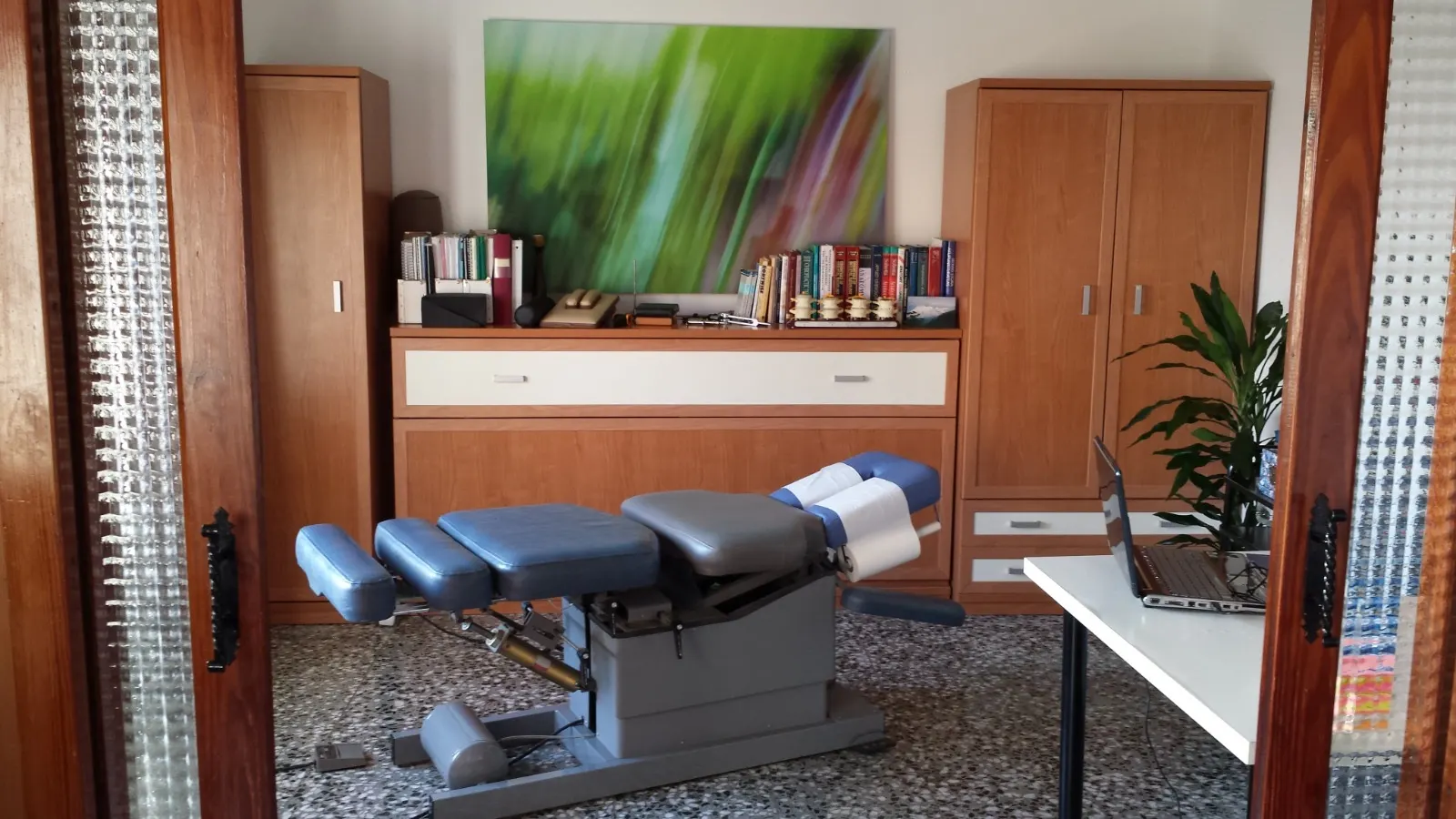
A calm, private room above Jávea Port — the same space, and the same practitioner, every visit.
Chiropractic focuses on the relationship between the spine and the nervous system. These are some of the complaints that tend to respond well to chiropractic care.
If your complaint is not listed, call us and we will tell you honestly whether we can help.
Pick an area and we will tell you what we commonly see there. This is not a diagnosis — that needs an examination.
Your first visit
We go through your background unhurriedly — injuries, illnesses and symptoms. This is what tells us whether chiropractic can help you.
A thorough physical examination: postural analysis, balance and sway, centre of gravity, palpation of the spine, and neurological and orthopaedic tests.
If the examination shows you are likely to benefit from chiropractic care, you will receive your first adjustment the same day.
We review the results of the tests together and, if appropriate, recommend a plan of care.
Just as a house needs foundations before walls, care of the spine follows an order.
Most people arrive in pain. The first goal is to get you feeling better. Visits are usually closer together in this phase.
Continued correction lets the muscles and tissues that support the spine recover. Visits spread further apart.
Once function is restored, periodic care helps prevent the problem returning.
What people most often ask before a first visit.
A natural method of health care focused on the relationship between the spine and the nervous system, without drugs or surgery. It is recognised by the World Health Organization.
A precise, controlled movement — usually by hand, sometimes with purpose-made instruments — applied to a joint that is not moving properly. The aim is to restore movement, position and function to that joint.
Often there is no sound at all. When there is, it is gas filling the partial vacuum created as the joint surfaces separate slightly. It is painless and harmless.
Chiropractic has a strong safety record. It is a conservative approach that avoids invasive procedures and medication.
No. Each person's situation is different and the plan of care follows from it. That is why the first visit begins with a history and examination.
No. An adjustment is a specific force, in a specific direction, on a specific joint. Twisting your own neck until it clicks is not the same thing, and it can further destabilise an area that is already unstable.
No. You may get used to feeling better, less tense and more energetic — but that is not dependence.
No. Chiropractic does not treat everything. If your case is not one for us, we will say so.
Yes. Techniques are always adapted to a patient's size, weight, age and state of health.